Compare fan airflow without mixing the units
Put cubic metres per hour and cubic metres per minute on the same basis while keeping air speed and electrical input separate.
Updated:

Keep the unit attached to the number
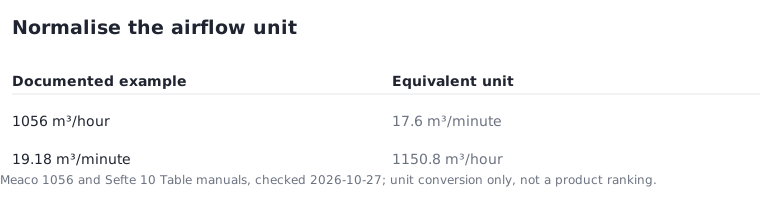
A fan airflow number without its unit is an incomplete specification. The MeacoFan 1056 manual lists 1056 m³/hour (cubic metres per hour) and 17.6 m³/minute (cubic metres per minute) in separate airflow fields. Dividing 1056 by 60 gives 17.6, so these two presentations are numerically consistent with the same volume-per-time scale.
Write the unit beside every copied value. Do not sort a shortlist by the largest printed number before converting it to a common basis. A value per hour naturally looks larger than an equivalent value per minute. This conversion does not tell you how the manufacturer measured the flow or how the appliance will feel in your room.
MeacoFan 1056 manual MF1056EN3, November 2022 ?
Convert one candidate, then retain the original
For a second documented example, the Sefte 10 Table manual lists a maximum airflow of 19.18 m³/minute (cubic metres per minute). Multiplying by 60 gives 1150.8 m³/hour (cubic metres per hour). Keep the original figure alongside your conversion so another reader can trace the arithmetic back to the source without searching for a rounded value that never appeared there.
The figures alone are not a recommendation that one fan is better for your room. Record the stated operating condition and measurement context, and ask about missing information. A normalised unit makes a comparison less confusing; it does not remove differences in the appliance design, settings or the information provided with the rating.
Meaco Sefte 10 Table manual UK02 ?
Do not swap airflow for air speed
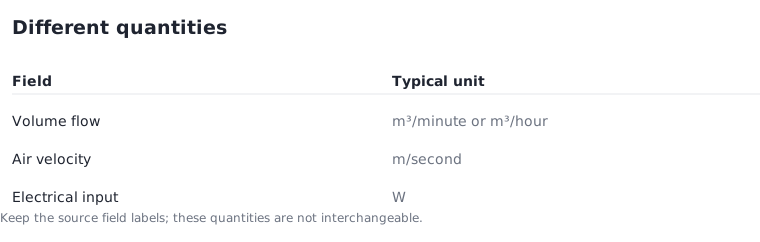
Volume flow and air speed describe different quantities. The same Sefte document separately labels maximum air velocity in metres per second. Preserve those field names when making a comparison. Do not place a metres-per-second figure in a column intended for cubic metres per minute, even if both appear near the word airflow on a retailer page.
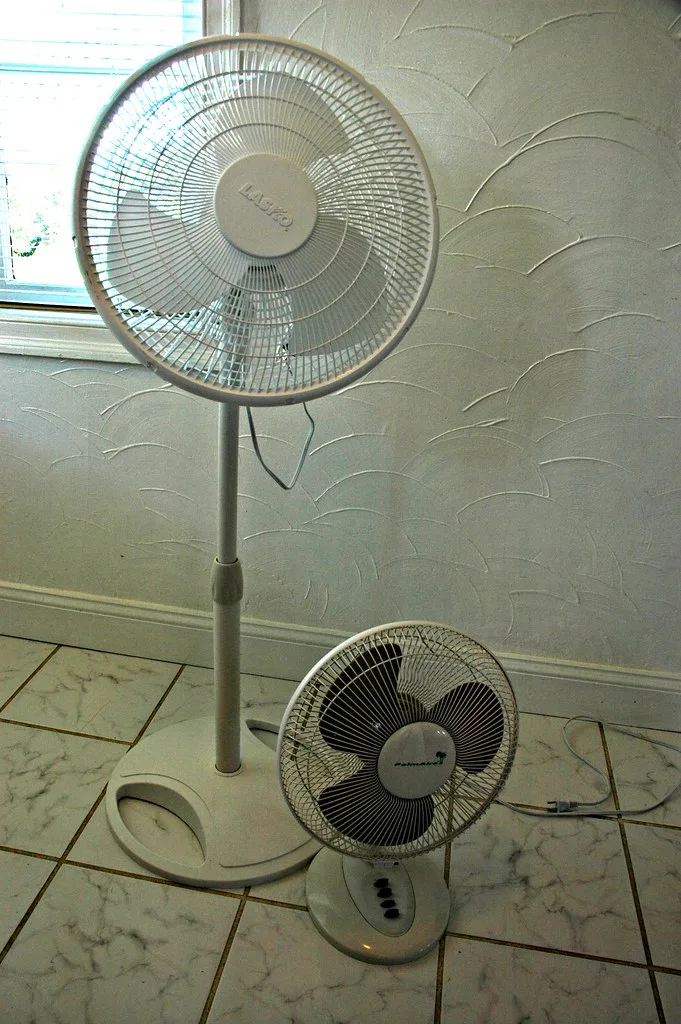
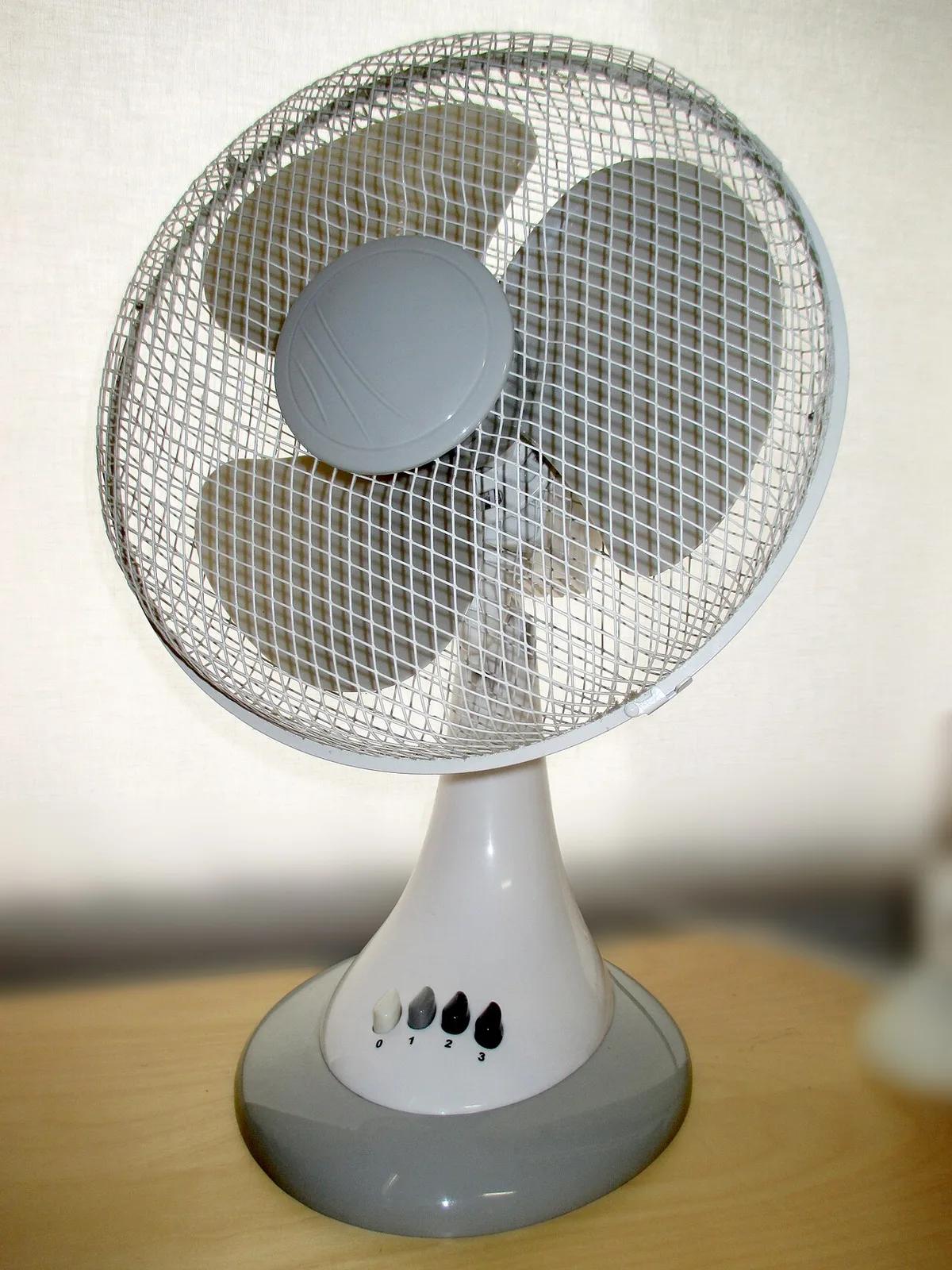
The close-up fan photograph shows a grille and blades, but it cannot supply either measurement. The paired photograph shows different physical formats, which also do not establish a measured flow. Treat photographs as evidence of visible form and controls, while taking numerical performance fields from an identified document with their units intact.
Meaco Sefte 10 Table manual UK02 ?

Keep electrical input in another column
Watts belong in an electrical-input column, not an airflow column. A fan can have several settings, and a specification may distinguish maximum, rated, standby or operating consumption. Copy the exact label before deciding which figure belongs in a cost scenario. Do not combine an airflow maximum and an unrelated low-power figure to create an unsupported efficiency claim.
A practical comparison sheet can have separate columns for original airflow, converted airflow, power-field label and the unresolved measurement conditions. Leave a cell blank or mark it unknown when the source does not provide the information. A tidy table with guessed entries is less useful than an honest table that reveals what you need to ask.
Use the result to narrow a question
After converting units, return to the intended position, controls and use. Decide whether the published information is sufficiently comparable to support your next step, or whether a manufacturer question remains. A higher volume-flow figure cannot establish the noise you will hear, the stability of the base or the suitability of the controls for your routine.
Save the two original manual links and your conversion formula with the shortlist. If a seller uses a different number, compare its label and model variant before calling it an error. This guide demonstrates arithmetic and source reading; it does not claim a laboratory airflow test or a measured ranking of the photographed fans.